
Assembly line automation uses robots, conveyor vision system, and software
to perform tasks like assembly, inspection, testing, and packaging, replacing manual labour for
increased efficiency, higher quality, faster production, and reduced costs in mass
manufacturing. This technology moves parts between workstations automatically, coordinating
operations for high-volume, repeatable, and precise output, evolving from basic
manual lines to complex, intelligent systems.
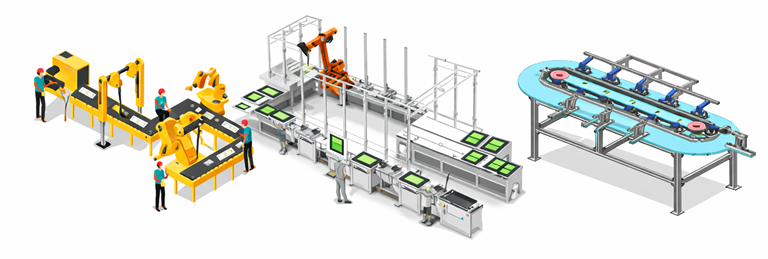
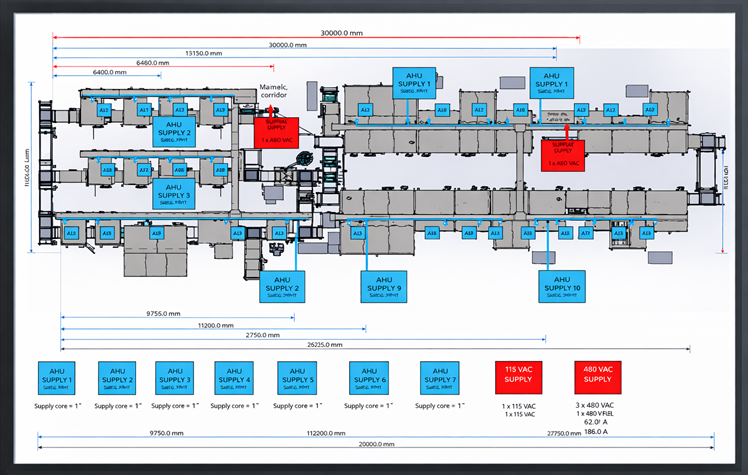
Sequential tasks: Raw materials enter one end, move through stations (like conveyors or Pallet Systems), and a finished product emerges from the other.
Automated workstations: Robotic arms, pick & place Units, and feeders handle tasks such as screwing, welding, testing, and marking
Centralized control: A central system manages all movements, data collection, and performance monitoring for consistency.
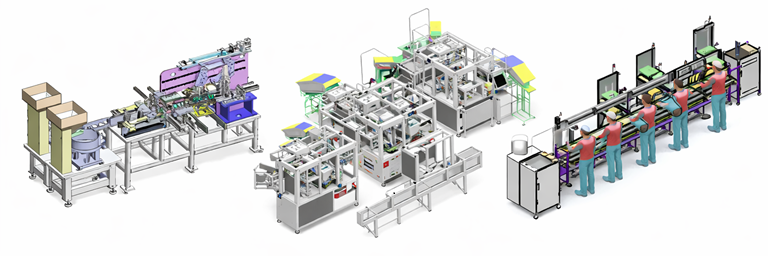
Robotics: Robotic Arms for complex assembly, fastening, and handling.
Conveyor Systems: Roller, chain, belt, and overhead conveyors to transport parts.
Vision Systems: For quality control, part identification, and precise positioning.
AGVs: Automated Guided Vehicles for material transport.
Software: Control systems and software for process coordination.
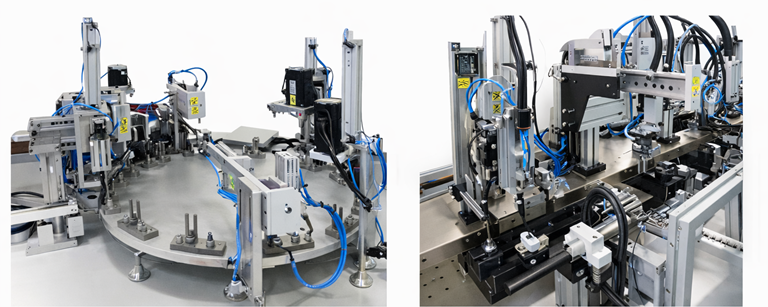
Increased Throughput: Automated systems can operate 24/7, often working 3–5 times faster than manual labor.
Enhanced Precision: Robots achieve tolerances as tight as ±0.01 mm, significantly reducing defects.
Cost Efficiency: While initial setup costs are high, companies typically see a 15–30% reduction in labor costs and achieve a full ROI within 12–24 months.
Worker Safety: Automation removes humans from hazardous environments involving heavy lifting, toxic substances, or extreme heat
Increased Efficiency & Speed: High throughput, reduced cycle times.
Improved Quality: Consistent, repeatable precision, fewer errors, and better traceability.
Cost Reduction: Lower labor dependency and significant cost savings over time.
Scalability: Easier to scale production without limitations of human workforce.
Fixed (Hard) Automation: Dedicated equipment for high-volume production of a single product. It is highly efficient but difficult to reconfigure.
Programmable Automation: Ideal for batch production; equipment can be reprogrammed to handle different product types.
Flexible (Soft) Automation: Advanced systems that switch between tasks with minimal downtime, suitable for custom manufacturing.
Lean Automation: A hybrid approach that adds automation only to specific steps where it adds clear value, relying on human labor elsewhere
AI-Driven Predictive Maintenance: Systems use real-time sensor data to predict and prevent machine failures before they occur.
Human-Robot Collaboration: Cobots are increasingly used to assist workers with dexterous tasks that robots cannot yet perform independently.
Digital Twins: Integration with Siemens Tecnomatix and other software allows for the simulation and validation of entire production lines before physical installation
