
Spring Machine Spring Coiling Machine These machines are the workhorses of the manufacturing world, turning straight wire into complex springs with incredible precision and speed.
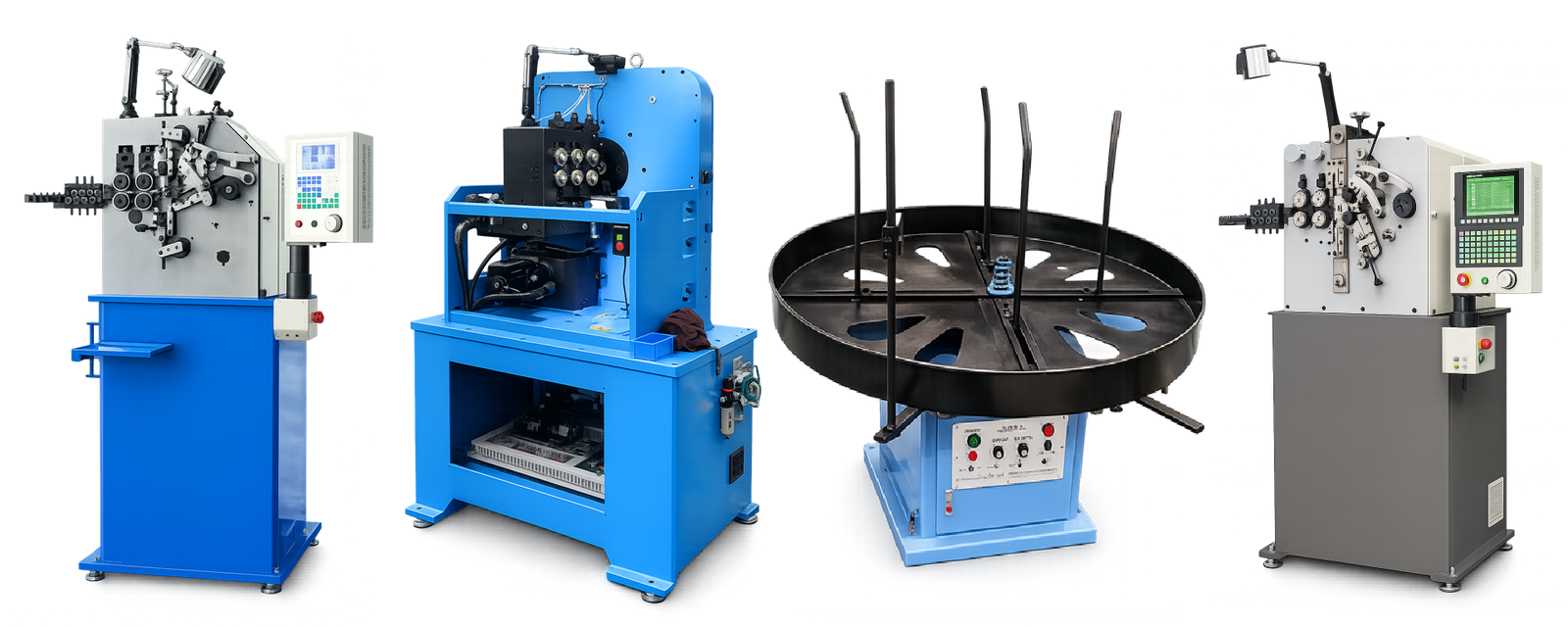
Wire Feed System: The horizontal rollers on the left pull the wire from a spool and straighten it before it enters the forming area.
Forming Slides: The various mechanical arms and tools arranged in a circular pattern in the centre. These hit, bend, and cut the wire to create specific shapes.
CNC Control Panel: The screen and keypad on the right. This allows the operator to program dimensions like pitch, diameter, and number of coils.
Tooling Area: The "heart" of the machine where the wire is forced against mandrels and coiling points.
The process is a blend of high-speed mechanical force and digital precision:
Feeding: The machine pulls wire through a series of straightening rollers.
Coiling: The wire is pushed against a coiling point (a hard tool) that forces the wire to bend into a circle. The angle of this tool determines the diameter.
Pitching: A "pitch tool" moves in and out to create the space between the coils.
Cutting: Once the programmed length is reached, a high-speed cutter shears the wire.
Machines like this are used to produce several types of springs:
Compression Springs: Found in mattresses, pens, and car suspensions.
Tension/Extension Springs: Used in garage doors and trampolines.
Torsion Springs: The type found in clothespins or heavy-duty machinery.
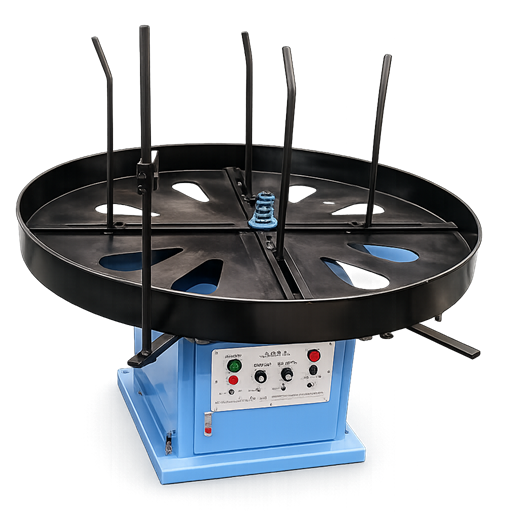
It is the essential companion to the CNC spring machine.While the spring machine does the high-speed bending, this machine ensures the wire gets there without tangling or snapping.
Think of this as a motorized turntable for heavy industrial wire. Its primary jobs are:
Holding the Payload: It supports large, heavy coils of wire (often hundreds of kilograms) that would be impossible for the spring machine to "pull" on its own.
Tension Management: It uses a sensor arm (that tall vertical rod you see) to detect when the spring machine is pulling wire. When the arm moves, the D-Coiler spins; when the pulling stops, the D-Coiler brakes.
Preventing Kinks: It ensures the wire feeds into the straighteners at a consistent speed and angle, which is critical for maintaining the precision of the final spring.
Adjustable "Core" Pins: Those black vertical bars on the tray can be moved inward or outward to fit the inner diameter of different wire coils.
Control Panel: Notice the dials on the blue base; these allow the operator to set the rotation speed and the sensitivity of the sensor arm.
Horizontal Orientation: This "flat" style is preferred for spring making because it allows the wire to spiral off naturally without twisting, which could affect the spring's diameter.
The D-Coiler and the spring machine are usually electronically "synced." If the D-Coiler runs too slow, the wire will snap; if it runs too fast, you get a "bird's nest" of tangled wire on the floor. The sensor arm acts as the bridge between them to keep the tension just right.
