
Fixtures Design & Develop
- Home
- Die, Jigs & Fixtures Design & Development
Fixtures are specialized, high-precision holding devices used in automotive manufacturing to securely locate, hold, and support components during assembly, welding, and inspection. Key in Body-in-White (BIW) production, they ensure accuracy for parts like doors and frames, reducing errors and ensuring dimensional quality.
These fixtures are primarily used in the production line to ensure parts meet strict specifications before final assembly.
Assembly Fixtures: These devices are designed to hold and position various components (like body panels, engine parts, and interior fittings) correctly while they are being joined, ensuring accurate fit and functionality.
Welding Fixtures: Used specifically to hold parts securely in place during welding operations (such as in the body-in-white (BIW) stage), which guarantees proper alignment and joint configuration to prevent distortion.
Checking/Inspection Fixtures: These tools are used for quality control to verify the dimensions, shape, and alignment of parts against design specifications using gauges, sensors, or coordinate measuring machines (CMMs).
Machining Fixtures: These hold the workpiece steady during various machining operations, including drilling, milling, and grinding, to achieve precise cuts and shapes.
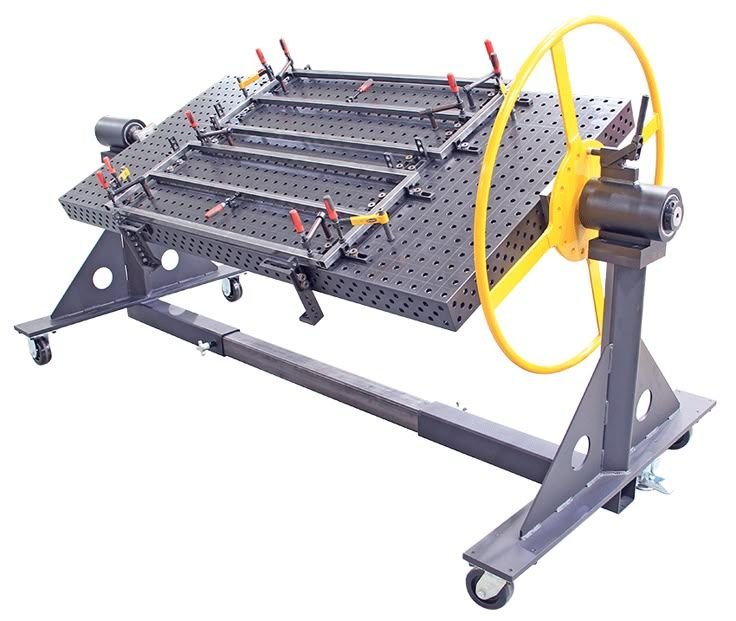
1. Welding Fixture : is used to accurately locate and hold components during welding to ensure proper alignment and dimensional accuracy.
2. Station wise Welding Fixture : is designed for specific welding stations to improve productivity, consistency, and process control.
3. Inspection Fixture : is used to check dimensional accuracy, geometry, and quality of components during or after manufacturing.
4. Panel Checker : is a specialized fixture used to verify sheet metal panel profiles, gaps, and flushness.
5. Assembly Fixture : helps in positioning and holding multiple parts correctly during the assembly process.
6. Machining Fixtures : are used to securely locate and support workpieces during machining operations for precision and repeatability.
7. Boring Fixtures : are designed to guide boring tools accurately to achieve precise hole size and alignment.
8. Grinding Fixtures : are used to hold components firmly during grinding operations to achieve accurate surface finish.
9. Tapping Fixtures : help in accurate and consistent threading operations by guiding the tapping tool properly.
10. Indexing Fixtures : allow controlled rotation of the workpiece for machining at fixed angular positions.
11. Duplex Fixtures : enable simultaneous machining of two components to increase productivity and reduce cycle time.
12. Broaching Fixtures : are used to hold components securely during broaching for precise profile generation.
Automated workstations: Robotic arms, pick & place Units, and feeders handle tasks such as screwing, welding, testing, and marking
Centralized control: A central system manages all movements, data collection, and performance monitoring for consistency.
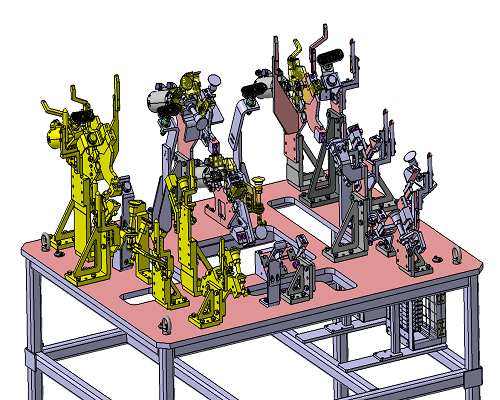
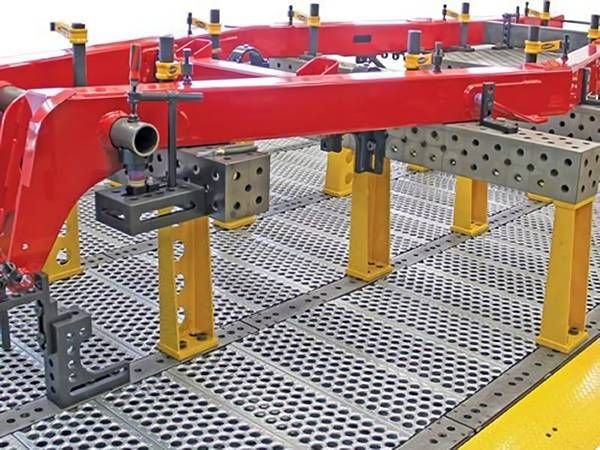
Welding fixtures are specialized tools used to securely hold and position workpieces during the welding process to ensure accuracy, consistency, and safety. They are crucial in both manual and automated manufacturing, helping to prevent distortion and improve productivity.
Welding fixtures come in various types, each suited for different production needs and welding processes
Manual Welding Fixtures: These are operated by hand and are best for small-scale production, custom jobs, or repair work. They are cost-effective and offer flexibility for tasks requiring a high degree of manual attention.
Modular Welding Fixtures: Designed for versatility, these systems use standardized components (plates, clamps, pins) that can be reconfigured for different projects. They are ideal for prototyping or workshops handling a variety of tasks.
Custom Welding Fixtures: Built specifically for unique part geometries or high-volume, automated production lines, these fixtures deliver maximum accuracy and efficiency for specific applications, such as in the automotive or aerospace industries.
Hydraulic & Pneumatic Fixtures: These use fluid pressure or compressed air, respectively, to clamp components with superior force and speed. They are ideal for high-speed, repetitive tasks in automated systems.
Robotic Welding Fixtures: Specifically engineered to integrate with robotic welding systems, these fixtures provide the stability and precision needed for automated, repeatable welds in high-volume manufacturing.
Using welding fixtures provides significant advantages in manufacturing and fabrication
Accuracy & Repeatability: They lock parts into a precise, consistent position every time, which minimizes misalignment and ensures uniform, high-quality welds across all products.
Increased Productivity: Fixtures streamline the workflow by reducing setup, loading, and unloading times, allowing welders to focus on the actual welding process.
Distortion Control: They help manage heat expansion and contraction during welding by securing parts tightly, which prevents warping or misalignment of materials.
Enhanced Safety: Fixtures hold workpieces firmly, reducing the need for operators to manually hold hot or heavy components, thus improving the overall safety of the work environment.
Efficiency: Reduces setup time and speeds up manual assembly by eliminating the need for repeated manual adjustments.
Consistency: Ensures every unit produced is identical, maintaining interchangeability of parts.
Safety: Reduces the risk of injury by securing heavy or hazardous components, allowing workers to focus on the assembly task rather than holding parts steady.
Cost Savings: While there is an initial investment, fixtures lower costs over time by reducing scrap, rework, and the need for highly skilled labor.
Commonly available welding fixtures and accessories include:
Magnetic Welding Holder: These magnetic clamps are made of high-quality steel and provide a strong grip (25 lbs holding force) for hands-free operation in various angles (45°, 90°, 135°).
Multiple Angle magnetic welding holder clamps set: This set includes arrow and triangle-type magnetic holders with varying pull forces for versatile positioning during welding, soldering, and assembly.
Manual Rotating Welding Fixture: Made of mild steel, this fixture is designed for industrial use and allows for the rotation of the workpiece, making it easier to weld from multiple sides.
Automotive: Assembling car body panels, engines, and interior fittings.
Aerospace: Precision alignment of fuselage sections, wings, and landing gear.
Consumer Goods: Efficient assembly of electronics, appliances, and medical devices.
custom solutions, many manufacturers now use 3D printing or additive manufacturing to create fixtures in-house, which can reduce costs by up to 65% compared to traditional machining methods.
