
Hydro Pneumatic Press Machine is essentially the "best of both worlds" solution in the machining world. It combines the speed and agility of a pneumatic system with the raw power and steady force of a hydraulic system.
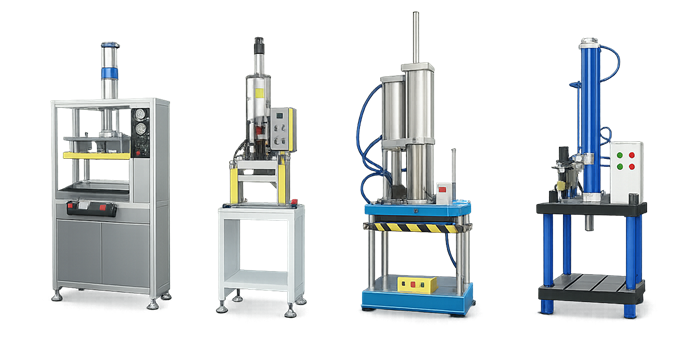
Unlike a standard pneumatic press, a hydro-pneumatic system operates in two distinct phases using a specialized cylinder that contains both air and oil.
1. The Approach (Pneumatic) Low-pressure compressed air moves the ram quickly toward the workpiece. This stage is fast and uses very little energy because no real "work" is being done yet—just positioning.
2. The Power Stroke (Hydraulic) Once the ram meets resistance (the workpiece), a mechanical valve triggers an internal "intensifier." A small piston is driven into a sealed oil chamber. Since liquids are incompressible, this creates a massive surge in pressure.
The force is calculated by the ratio of the surface areas of the pistons: F = PXA
Where F is force , P is pressure , and A is the area of the piston. By using a small air piston to drive a larger hydraulic volume, the machine multiplies the input force significantly.
| Feature | Hydro-Pneumatic | Standard Pneumatic | Standard Hydraulic |
|---|---|---|---|
| Power | High (up to 100+ tons) | Low to Medium | Very High |
| Speed | Fast (Rapid approach) | Very Fast | Slower |
| Energy Use | Low (Air used mostly) | Medium | High (Motor runs constantly) |
| Footprint | Compact | Small | Large (Needs oil reservoir) |
| Precision | High (Smooth oil flow) | Low (Air "bounces") | Very High |
Performance: They deliver high force (typically 1–45+ tonnes) while maintaining the speed of pneumatic systems.
Operation: The system uses compressed air to drive a piston that pressurizes hydraulic oil, often using two cylinders for approach and working strokes.
Efficiency: They are considered cost-effective, low-maintenance, and quiet alternatives to pure hydraulic presses.
Structure: Available in various configurations, including 2-column, 4-column, and C-frame designs.
Applications: Ideal for riveting, punching, assembling, blanking, and marking.
Structures: Single C-frame, 2-pillar, and 4-pillar designs.
Components: Often include oil reservoirs, air-over-oil intensifiers, and sturdy frames.
Special Features: Some models feature full aluminium housing, magnetic position sensing, and low energy consumption.
Customization: Bed sizes can be customized for specific, large, or complex jobs.
Heavy-duty riveting
Stamping, pressing operations.
Deep drawing or forming
High-force punching through thick steel
Assembly Riveting and assembly of components.
Clinched joints (joining sheet metal without fasteners)
