
Pneumatic Press Machine is a power press that utilizes compressed air to generate force for a variety of industrial tasks, such as punching, stamping, forming, riveting, and assembly. These machines are known for their speed, energy efficiency, and adjustable force capabilities, making them versatile for light to medium-duty operations.
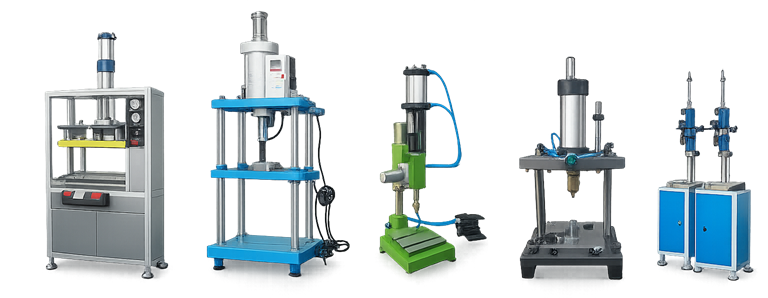
Pneumatic presses offer a distinct set of features that make them a valuable asset in many manufacturing and assembly processes.
Adjustable Force: The force exerted can be easily fine-tuned by adjusting the air pressure, allowing for both delicate and heavy-duty tasks.
Safety: They are considered safe by design because they do not store energy when idle, reducing the risk of inadvertent operation or dangerous discharge during a power failure.
Energy Efficiency: These machines only consume power during the pressing cycle, making them an energy-efficient choice compared to some other machinery types.
Lower Maintenance: With a simpler design and fewer moving parts than mechanical presses, they generally require less maintenance and have a lower failure rate.
Speed and Control: Pneumatic presses generally offer rapid execution for quick cycle times, and their precise control over stroke length and pressure is a standout feature.
Low Noise Operation: Many models operate quietly, often below 75 dB, making them suitable for noise-sensitive environments.
Frame Types: They are available in various frame configurations, including C-frame and H-frame (or pillar type), to suit different workspace and application needs.
The versatility and control of pneumatic presses make them suitable for a wide range of industrial applications.
Metal Forming: Used for shaping metal sheets and components.
Assembly: Essential for precise assembly of various components, such as automotive interior panels and electronic parts.
Punching and Stamping: Ideal for creating holes or specific shapes in materials.
Riveting and Crimping: Used for joining materials securely.
Material Testing: The controllable force makes them useful for various material testing applications.
Pneumatic Cylinder: The "engine" where the air pressure is converted into linear motion.
Control Valves: These manage the timing, pressure, and direction of the airflow.
The Ram: The part that actually comes into contact with the workpiece or die.
FRL Unit (Filter, Regulator, Lubricator): Ensures the air is clean, at the right pressure, and slightly lubricated to protect internal seals.
At its core, a pneumatic press converts the energy of compressed air into mechanical motion.
Air Intake: A compressor forces air into a storage tank.
Directional Control: When the operator activates the machine, a valve opens, allowing the high-pressure air to enter the cylinder.
The Piston Stroke: The air pushes against a piston, which moves the ram (the moving part of the press) downward with significant force.
Exhaust: Once the task is complete, the air is exhausted through a valve, and a spring or air return brings the piston back to its starting position.
| Feature | Advantage | Trade-off |
|---|---|---|
| Speed | Much faster cycle times than hydraulic presses. | Less "tonnage" (force) than hydraulic options. |
| Maintenance | Fewer moving parts and no messy oil leaks. | Requires a consistent supply of compressed air. |
| Precision | Excellent for repetitive, light-to-medium tasks. | Air is compressible, making precise depth control tricky. |
| Safety | Generally safer and easier to stop mid-cycle. | Can be noisy due to air exhaust. |
